



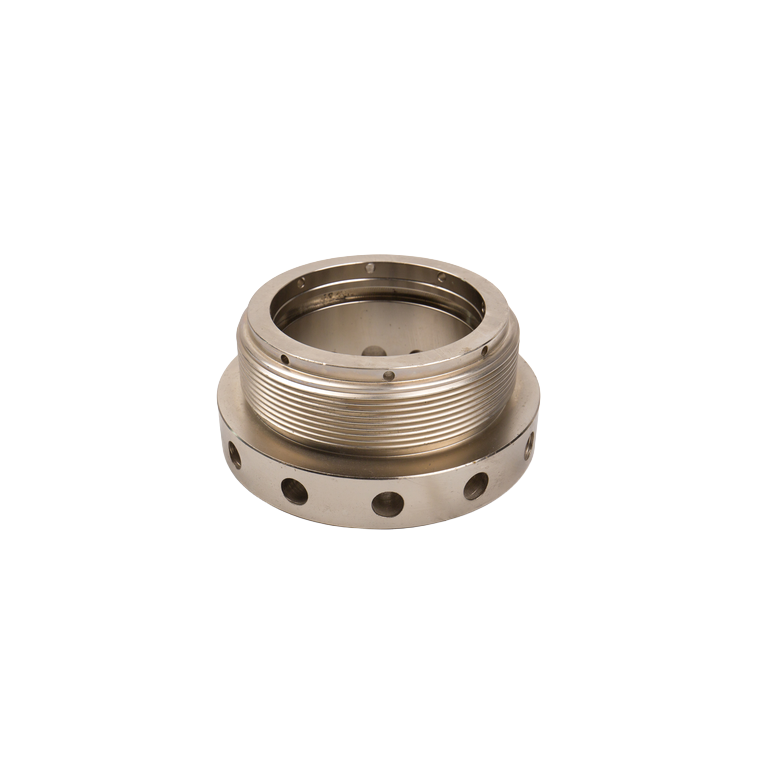
Product Introduction of Plunger Cap
The plunger cap is a pressing and adjusting component in the plunger sealing system of a plunger pump. It is usually installed at the outer end of the packing box and is used in conjunction with the packing gland, plunger packing and packing box. Its main function is to apply axial force to the internal sealing components through threads or corresponding clamping structures, keeping the plunger packing in an appropriate compressed and installed state.
When the plunger pump is in operation, the plunger continuously performs reciprocating motion, and the plunger packing needs to form a dynamic seal around the outer circle of the plunger. The plunger cap helps maintain the required contact state between the seal and the plunger by applying compression force to the packing gland or packing assembly, and at the same time provides structural conditions for inspection and adjustment of the packing after wear.
The plunger cap is not a sealing component that directly undertakes the main sealing function, nor is it an ordinary fastening nut. It belongs to the functional compression part of the plunger seal assembly. Its thread specification, axial length, compression end face and the fit relationship with the packing box all need to be matched with the specific model of the plunger pump.
The main function of the plunger cap
1. Compression packing assembly: By tightening or corresponding mechanical compression methods, the axial force is transmitted to the packing gland and the internal plunger packing, keeping the packing in the specified assembly state.
2. Adjust the sealing state: When the packing undergoes certain wear or compression changes after long-term use, the compression state can be adjusted according to the maintenance requirements of the corresponding equipment to keep the sealing components in a reasonable working condition.
3. Maintain the position of the packing: Together with the packing box and the packing gland, it forms an axial retention structure to prevent abnormal axial movement of the internal packing assembly under the reciprocating motion of the plunger and pressure.
4. Easy to disassemble and assemble for maintenance: After removing the plunger cap, the internal parts of the packing gland, plunger packing, spacer ring and packing box can be further inspected and replaced.
Working principle
The plunger cap usually generates axial displacement through the thread or other clamping structure that cooperates with the packing box. When the pressure cap is adjusted inward, its force is transmitted to the packing gland or directly acts on the specified clamping component, further compressing the packing assembly.
After the packing is axially compressed, it will produce a corresponding radial sealing effect according to its structure, thereby forming a dynamic seal in conjunction with the outer circle of the plunger. Therefore, the adjustment state of the plunger cap will affect the tightness of the packing, but the actual adjustment amount should be carried out in accordance with the maintenance requirements of the specific pump type and packing structure.
The relationship with packing boxes, packing and gland covers
The plunger packing box is the main installation body of the sealing assembly, and it is used inside to accommodate parts such as the plunger packing, spacer rings, and guide components. The plunger packing works directly around the reciprocating plunger and undertakes the main dynamic sealing task. The packing gland is responsible for transmitting the axial clamping force to the packing. The plunger cap is used to generate, maintain or adjust this clamping force.
Therefore, when inspecting the plunger seal system, the pressure cap, pressure cover, packing box, plunger packing and the surface condition of the plunger should be checked together. It is not advisable to determine the failure of a single part solely based on the leakage phenomenon.
Product features
The clamping function is clear: It is mainly used for axial clamping and installation holding of the plunger packing system, which is different from the application of ordinary connecting nuts.
The thread matching requirements are high: The diameter, pitch, direction of rotation and effective length of the pressure cap thread need to be exactly matched with the packing box.
The compression end face should be stable: The end face in contact with the packing gland or the internal compression part should meet the corresponding assembly requirements to avoid affecting the compression state of the packing due to skewed force.
Easy to adjust and maintain: The external structure is usually set up to suit the operation of the corresponding tools, facilitating disassembly, installation and adjustment during equipment maintenance.
Common examination areas
During use, special attention should be paid to inspecting the thread of the plunger cap, the clamping end face and the force-bearing part of the tool. If there is thread wear, random threading, deformation, cracking or abnormal wear on the compression end face, it may affect the normal adjustment of the pressure cap and the force state of the packing assembly.
If it is found that the pressure cap has been adjusted to a relatively deep depth but there is still abnormal leakage in the packing area, the compression amount should not be continuously increased indefinitely. Instead, it is necessary to check whether the plunger packing meets the replacement conditions and simultaneously inspect whether there is abnormal wear on the surface of the plunger, the packing box and the packing gland.
Key points for selection
The plunger cap is a special part that matches the height of the packing box. When purchasing, it is recommended to focus on confirming the following information:
1. Brand, series and specific model of plunger pump;
2. Plunger diameter and packing box specifications;
3. Outer diameter of the pressure cap, total height and main structural dimensions;
4. The diameter, pitch and direction of the thread that fits with the packing box;
5. Dimensions of the compression end face and internal through holes;
6. External tool operation structure or disassembly and assembly form;
7. Specifications of the matching packing gland and packing assembly;
8. Original part number, physical sample or technical drawing.
Installation and Maintenance
Before installing the plunger cap, it is necessary to check whether the mating threads of the packing box are clean and intact, remove impurities from the threads and the pressing end face, and confirm that the packing, the cap and other internal components are installed in place in the prescribed sequence.
When screwing in the pressure cap, it should be kept coaxial with the packing box to avoid forced diagonal threading which may cause damage to the threads. When adjusting the packing for compression, it should be carried out in accordance with the maintenance requirements of the corresponding equipment and packing assembly to avoid leakage due to insufficient compression, as well as increased friction of the plunger, temperature rise of the packing and abnormal wear due to excessive compression.
Before adjusting, disassembling or maintaining the packing of a high-pressure plunger pump, the shutdown, pressure relief and medium isolation should be completed in accordance with the equipment operation procedures. Only after confirming that there is no residual pressure in the system can the operation be carried out.
Procurement Instructions
Juli Petroleum Drilling and Production Equipment Co., Ltd. provides plunger caps and related accessories for plunger pump and plunger sealing systems. The plunger caps of different pump types may vary in terms of thread, shape, compression end face and tool operation structure. When purchasing, it is recommended to provide the pump model, plunger specification, packing box specification, original part number, physical size or technical drawing to accurately verify the product.