


Introduction to Spring Products
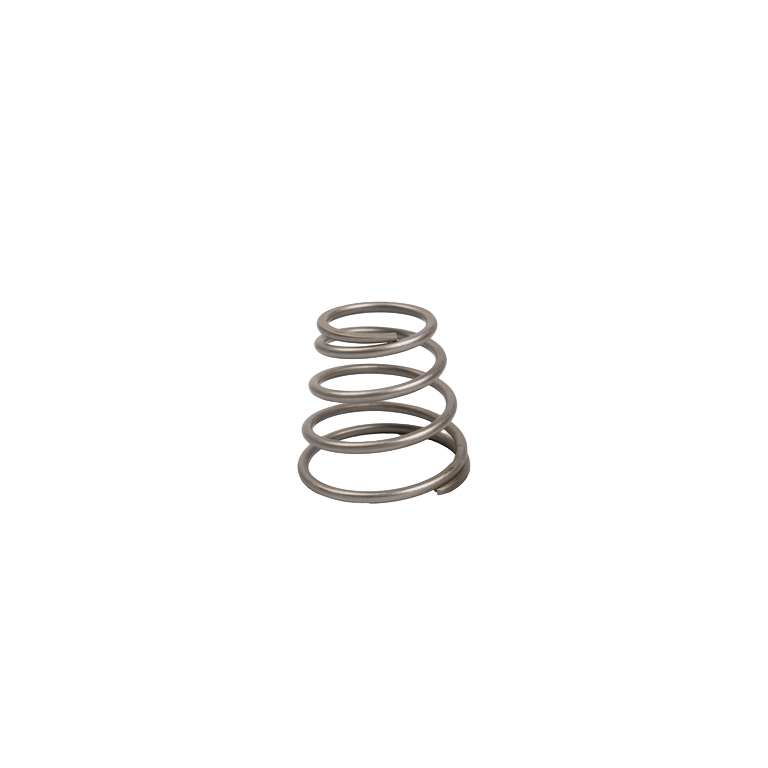
Springs are important elastic components in the suction and discharge valve assemblies of the hydraulic end of plunger pumps. They are usually used in conjunction with valve bodies, valve plates, valve seats, spring supports, spring brackets or retainers to provide return force for the valve components and maintain the normal opening and closing state of the valve group during reciprocating operation.
When a plunger pump is in operation, the reciprocating motion of the plunger causes periodic pressure changes inside the hydraulic end. When the pressure difference on both sides of the valve component reaches the opening condition, the valve body or valve plate overcomes the spring force and leaves the valve seat, allowing the medium to pass through. When the pressure difference drops or the flow direction changes, the spring pushes the valve component back to its original position towards the valve seat, enabling the valve to close in time and prepare for the next working cycle.
Therefore, the plunger pump valve spring is not merely a common compression spring used for "support". Its free height, wire diameter, outer diameter, effective turns, and spring stiffness will all affect the valve opening resistance, return speed, valve lift, and dynamic response. The actual specifications should be matched according to the pump type and valve group design.
The main function of a spring
1. Push the valve component back to position: After the suction or discharge process is completed, the spring pushes the valve body or valve plate to move towards the valve seat, helping the valve close in time.
2. Maintain the initial closed state of the valve assembly: When there is not enough opening pressure difference, the spring applies a certain pre-tightening effect to the valve components, keeping them in the correct working position near the valve seat.
3. Impact on the dynamic response of valves: The stiffness of the spring and the preloading state will affect the opening speed, return speed of the valve components, as well as the motion characteristics of the valve under high-frequency reciprocating conditions.
4. Coordinate to restrict the movement of valve components: The spring works together with the spring support, bracket, reholder and valve body to maintain the correct installation posture within the specified space and control the movement of valve components in coordination with the valve group structure.
Suction valve spring and discharge valve spring
The hydraulic end of a plunger pump is usually equipped with both an intake valve and an discharge valve at the same time. Springs can be configured for both valve groups. In the publicly available structural data of the plunger pump, both the suction valve and the discharge valve are respectively listed with valve plates, valve seats, springs and guide parts.
However, the suction spring and the discharge spring are not necessarily exactly the same. Different pump types may be equipped with different spring specifications based on valve diameter, working pressure, valve mass, allowable lift and flow characteristics. Therefore, when purchasing, it should be clearly determined whether the spring belongs to the suction end or the discharge end, and it cannot be replaced merely based on similar shapes.
Some plunger pump valve groups also adopt an inner and outer double-spring structure, with the two springs working together. In the public accessory information, separate "Valve Spring, Outer" and "Valve Spring, Inner" parts can be seen. Therefore, for this type of pump, it is also necessary to confirm whether it is an inner spring or an outer spring.
Working principle
During the suction stroke, when the pressure in the pump chamber is lower than the pressure on the suction side and overcomes the force of the suction valve spring, the suction valve opens and the medium enters the pump chamber. When the suction stroke ends and the pressure conditions change, the spring pushes the suction valve member back towards the valve seat.
During the discharge stroke, when the pressure in the pump chamber rises and overcomes the pressure on the discharge valve spring and the discharge side, the discharge valve opens and the medium is discharged. Subsequently, the spring pushes the discharge valve back to its original position and closes.
Excessive spring force may increase the opening resistance of the valve component, while insufficient spring force may cause the valve component to close in time or have unstable movement. Therefore, the actual spring parameters should be consistent with the original valve group design.
Fit with spring supports and spring brackets
The spring itself provides elastic return force. The spring support mainly serves to support and position the end of the spring. The spring bracket or retainer can, depending on the structure, undertake functions such as fixation, limiting, and valve lift constraint.
Although the three are installed in adjacent positions, their functions are different: the spring is responsible for generating elastic force, the spring support is responsible for providing support, and the spring bracket or retainer is responsible for fixing and restricting the installation position. They should not be treated as the same type of accessory.
Common failure forms
The valve spring is constantly in a state of high-frequency compression and release for a long time, which may lead to problems such as fatigue, decrease in free height, elastic attenuation, local deformation, fracture, corrosion or surface erosion.
When the spring tilts, breaks or its stiffness significantly decreases, it may cause the valve components to not return to their original position in time, abnormal closing state, unstable operation of the valve group or abnormal impact.
When inspecting the spring, one should not only observe whether it is broken, but also check the free height, end face condition, coil deformation and corrosion, and at the same time inspect the valve body, valve seat, spring support and retaining parts.
Key points for selection
The plunger pump valve spring is a special accessory directly related to the dynamic performance of the valve group. When purchasing, it is recommended to focus on confirming the following information:
1. Brand, series and specific model of plunger pump;
2. Hydraulic end or valve box model;
3. Is it used for the suction valve or the discharge valve?
4. Single spring or double spring structure both inside and outside;
5. Outer diameter and inner diameter of the spring;
6. Wire diameter;
7. Free height;
8. Valid laps and total laps;
9. Spring end form;
10. Original part number, physical sample or technical drawing.
Installation and Inspection
Before installing the spring, it is necessary to check whether there is abnormal wear or skew on the spring support, bracket, valve body and valve seat, and confirm that the spring can be correctly positioned according to the original structure.
After installation, the spring should remain in a normal axial state and should not show obvious bending, jamming or eccentric compression. For the inner and outer double-spring structure, it is necessary to confirm that the specifications and installation relationship of the inner and outer springs are correct.
It is not recommended to change the preload state of the spring by arbitrarily shortening the spring, stretching the spring or adding gaskets, as this will alter the opening and closing characteristics of the valve. The spring force, preload and valve lift should be in accordance with the original design requirements of the corresponding pump type.
Before overhauling the hydraulic end valve assembly, the machine should be shut down in accordance with the equipment operation procedures and the pressure should be completely released. Only after confirming that there is no residual pressure in the pump cavity and related pipelines should the valve assembly be disassembled.
Procurement Instructions
Juli Petroleum Drilling and Production Equipment Co., Ltd. provides spring and piston pump hydraulic end valve group accessories. The suction valve springs, discharge valve springs and inner and outer double springs of different pump types may vary in terms of outer diameter, wire diameter, free height, number of turns and spring characteristics. When purchasing, it is recommended to provide the pump model, valve group position, original part number, physical size of the spring or technical drawings to accurately verify the product.