



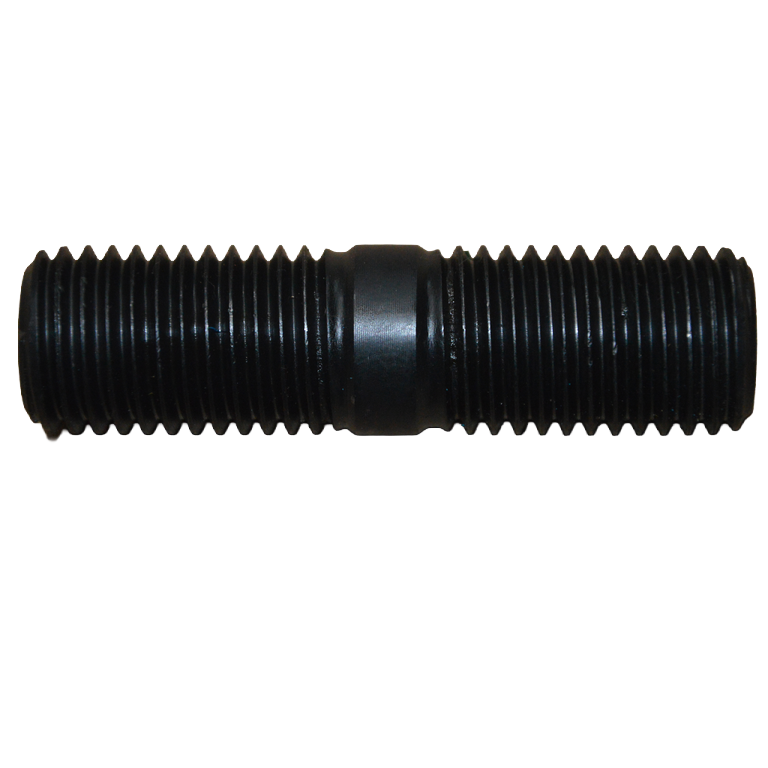
Introduction to Stud products
Studs are special fasteners used in the structural connection of plunger pumps. They usually adopt double-ended threads or full-threaded rod structures and are used for the connection and fastening between the pump body, hydraulic end, end cover, bearing housing and other detachable components. Unlike ordinary hexagonal head bolts, the stud itself usually does not have a hexagonal head for direct tightening with a wrench. Its connection mainly relies on the thread being screwed into the main body and cooperating with the nut to generate clamping force.
In a typical double-ended stud connection, one end is screwed into the internal threaded hole of the pump body or the corresponding main body part to the specified depth, passing through the connected part in the middle, and a nut and the corresponding washer are installed at the other end. After the nut is tightened, the stud undergoes axial tension, thereby exerting a continuous pre-tightening and clamping effect on the connected components.
During the operation of a plunger pump, there are vibrations, alternating loads and periodic mechanical actions. Therefore, the diameter, pitch, insertion length, material strength and pre-tightening state of the studs all need to be matched with the specific installation position. The key connection positions cannot be replaced by ordinary studs merely based on the outer diameter and total length.
The main function of studs
1. Connect the structural components of the plunger pump: The studs, the internal threads of the main body, the connected parts and the nuts together form a detachable connection, maintaining the correct assembly relationship of the relevant components.
2. Establish and maintain preload: After tightening the nut, the stud undergoes axial elastic elongation, thereby pressing the connecting parts tightly and reducing the loosening of the mating surface and abnormal displacement during operation.
3. Reduce repeated disassembly and assembly of the internal threads of the main body: For structures that require regular disassembly and maintenance, the end of the stud that is screwed into the main body can remain relatively fixed. During maintenance, the outer nuts are mainly disassembled and assembled, thereby reducing the wear caused by frequent screwing in and out of the internal threads of the main body.
4. Adaptation to thicker connecting parts: The stud length can be matched according to the connection structure, and is suitable for end covers, shells, flanges and other connection positions with a certain assembly thickness.
Structure and connection method
The studs used in plunger pumps can be double-ended studs or full-threaded studs depending on the specific structure. Double-ended studs are usually composed of threads at the screw-in end, the middle rod section and the nut end. The all-threaded structure processes threads along a larger range of the rod body.
Screw-in end: It fits with the internal threads of the pump body, hydraulic end or other main parts. The thread specification and effective screw-in depth directly affect the connection reliability.
Nut end: After passing through the connected part, it fits with the nut, and the specified connection preload is established through the tightening of the nut.
Middle rod section: Some studs are provided with smooth rod sections. Their diameters, lengths, and the relationship with the connection holes should be determined according to the original structure and cannot be simply replaced by fully threaded rods.
The difference from hexagonal head bolts
Hexagonal head bolts have a clearly defined hexagonal head. During installation, they are usually tightened by rotating the bolt head or the matching nut. Studs usually do not have bolt heads. Instead, they are formed by screwing one end into the main body and installing a nut at the other end, or by forming a clamping connection with nuts at both ends.
For the components of the plunger pump that need to be disassembled frequently, using stud connections can reduce the repeated disassembly and assembly of the main body's threaded holes. Therefore, even if the thread diameters and lengths are close, studs and ordinary hexagonal head bolts should not be directly interchanged without confirming the original design.
Selection of the screw-in end and the nut end
For double-ended studs, the threads at both ends should not be exactly the same by default. When actually selecting the model, it is necessary to separately verify the thread diameter, pitch, effective length of the screw-in end and the nut end, as well as the original designed screw-in depth.
If the length of the screw-in end is insufficient, it may result in insufficient effective meshing of the main body's threads. If it is screwed in too deep, top and bottom, interference or changes in the exposed length may occur. Therefore, during installation, the screw-in position should be controlled in accordance with the corresponding pump type and part drawings.
Common failures and inspection sites
When inspecting studs, special attention should be paid to checking the threads at both ends, the end area of the threads, the transition part between the smooth rod and the threads, and the surface of the rod body to observe whether there are any random threads, scratches, corrosion, bending, abnormal elongation or cracks.
For connection positions that are subject to cyclic loads for a long time, the root of the thread and the transition area of the cross-section are key inspection areas. If the studs repeatedly loosen, it is also necessary to check the preload status of the matching nuts, washers, internal threads of the main body, mating surfaces and adjacent studs.
When the internal threads of the main body show signs of slippage, scratches or insufficient effective meshing, merely replacing new studs cannot restore a reliable connection. At the same time, the main body threads should be dealt with in accordance with the equipment maintenance requirements.
Key points for selection
When purchasing plunger pump studs, it is recommended to focus on confirming the following information:
1. Brand, series and specific model of plunger pump;
2. Specific installation positions of the studs and connecting components;
3. Double-ended studs or full-threaded studs;
4. Thread diameter, pitch and effective length at the screw-in end;
5. The diameter, pitch and effective length of the thread at the nut end;
6. Total length of the studs and dimensions of the middle rod section;
7. The specified depth of the main body's screw-in;
8. Matching nuts, washers and anti-loosening structures;
9. Original design materials, strength and heat treatment requirements;
10. Original part number, physical sample or technical drawing.
Installation and Maintenance
Before installation, the external threads of the studs and the internal threads of the main body should be cleaned. Check whether there are burrs, random threads, corrosion or mechanical damage on the threads, and confirm that the screw-in end and the nut end are not installed in reverse.
When screwing the studs into the main body, they should be kept coaxial to avoid forced screwing causing cross-threads. The screw-in depth, thread lubrication method, thread locking method and exposed length should be carried out in accordance with the maintenance requirements of the corresponding pump type.
The nuts at the multi-stud connection parts should be tightened step by step and evenly in accordance with the prescribed sequence to avoid uneven force on the mating surface. The final tightening torque or other pre-tightening methods should be determined based on the stud specification, material grade, lubrication status and equipment maintenance documents. Uniform empirical values should not be used to replace the original equipment requirements.
Procurement Instructions
Juli Petroleum Drilling and Production Equipment Co., Ltd. provides screw and plunger pump fastening connection accessories. Studs installed at different positions may vary in terms of the threads at both ends, total length, effective thread length, rod structure, material strength and pre-tightening requirements. When purchasing, it is recommended to provide the pump model, installation position, thread specifications at both ends, original part number, physical dimensions or technical drawings to accurately verify the product.