



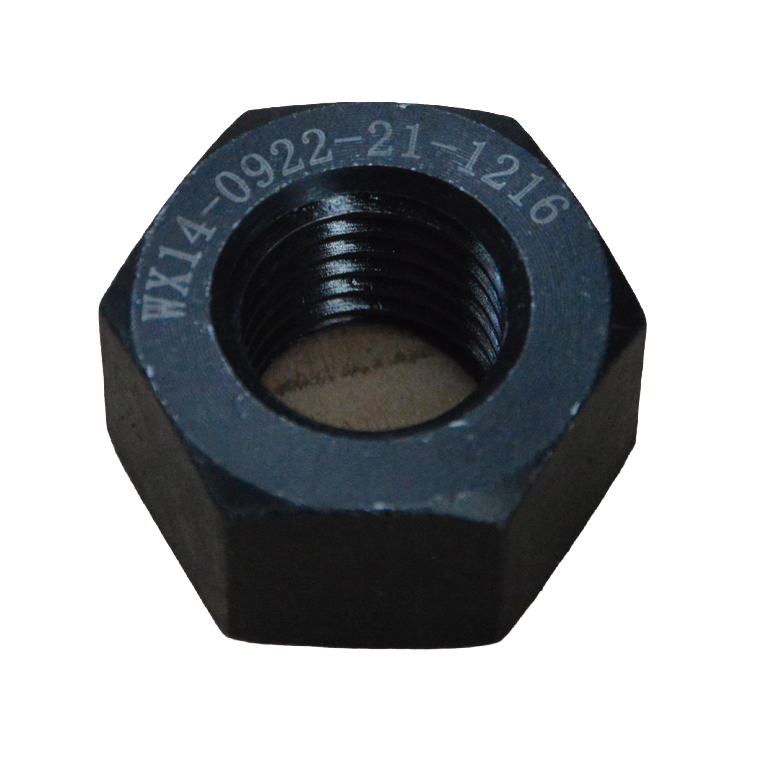
Product Introduction of Nuts
Nuts are commonly used fastening accessories in the structural connection of plunger pumps. They are usually used in conjunction with studs, hexagon head bolts or other connecting parts with external threads. By screwing through internal threads, they generate axial clamping force to fasten and hold the pump body, hydraulic end, end cover, bracket, bearing housing and other structural components.
During the operation of a plunger pump, vibration, periodic loads and mechanical shocks will occur. Therefore, the nut not only needs to be exactly the same as the matching external thread in terms of diameter, pitch and thread type, but also needs to meet the strength, pre-tightening and anti-loosening requirements of the corresponding installation position.
Nuts used in different positions may vary in terms of the size of the opposite side, thickness, strength grade, anti-loosening structure and surface treatment. When making a purchase, one should not merely judge whether it is applicable based on the fact that it can be screwed on, but should select the type in combination with the specifications of the matching studs or bolts and the requirements of the original parts.
The main function of a nut
1. Forming a threaded connection with bolts or studs: The nut is screwed in with the external thread fastener through the internal thread to form a detachable mechanical connection.
2. Establish the connection preload: After tightening the nut, the matching bolts or studs will be axially stretched, thereby pressing the connected parts together.
3. Maintain the assembly position of structural components: Nuts, washers, studs and connecting surfaces work together to keep the relevant components in the specified installation position and clamping state during operation.
4. Facilitates equipment disassembly, assembly and maintenance: The threaded connection can be disassembled and reassembled according to maintenance requirements, facilitating regular inspection and parts replacement of the plunger pump.
Working principle
When the nut rotates, the internal thread moves axially along the matching stud or the external thread of the bolt. When the nut comes into contact with the connected part or washer and is tightened further, it will cause a certain elastic elongation of the bolt or stud, thereby forming a continuous clamping force on the connected part.
For plunger pumps, an appropriate pre-tightening state can reduce loose connection surfaces, relative slippage and abnormal vibration. If the pre-tightening is insufficient, it may cause loosening or impact. If the fastening is excessive, it may cause damage to the threads, abnormal stretching of the studs or excessive force on the connecting parts.
Therefore, the final tightening state of the nut should be determined according to the corresponding pump type, installation position, thread specification and maintenance technical requirements. A uniform torque should not be applied to all plunger pump nuts.
Thread and matching relationship
The most crucial matching parameter of a nut is the internal thread. The nominal diameter, pitch, type and direction of rotation of the thread must be consistent with the matching studs or bolts.
For imported or matching plunger pumps with imperial threads, metric nuts cannot be used as substitutes merely based on the measured approximate diameter. Similarly, even if the nominal diameters of coarse-threaded and fine-threaded threads are the same, they cannot be directly interchanged.
If the nut can be screwed in with a small number of threads but tightens quickly, stop immediately and check whether there is a mismatch in pitch, thread type or tooth profile to avoid forced tightening causing thread damage.
The differences from packing nuts and pressure caps
The "nut" referred to in this product is a structural fastener, mainly used for studs, bolt connections and structural pre-tightening.
Packing nut: It is a special adjusting part for the plunger sealing system, mainly used for tightening and adjusting the plunger packing.
Pressure cap: It is usually a dedicated clamping part for the hydraulic end valve box or corresponding components, mainly responsible for the axial holding of components such as the pressure cover and the plug.
Common structure nut: Its main function is to form a tight connection with studs or bolts. Although all three types of parts may adopt the internal thread structure, their installation positions and functions are obviously different and cannot be mixed.
Anti-loosening structure
During the operation of the plunger pump, there are continuous vibrations and periodic loads. Some connection positions will adopt flat washers, spring washers, lock plates, double nuts or other anti-loosening measures according to the original design.
The anti-loosening method should be restored according to the original equipment structure. The original locking parts should not be removed at will just because the nut specifications are the same, nor should the anti-loosening structure be changed without technical basis.
Common failures and inspection sites
When inspecting nuts, special attention should be paid to checking the internal threads, hexagonal force-bearing surfaces, pressure-bearing end faces and external structures to observe whether there are any random threads, stripped threads, cracks, hexagonal rounded corners, corrosion and abnormal deformations.
If the nut repeatedly loosens, it is not only necessary to replace the nut alone, but also to check the thread condition of the matching studs or bolts, washers, anti-loosening structures, connection surfaces and whether the pre-tightening is uniform.
When the internal thread has already shown obvious scratches, stripped threads or plastic deformation, it is not recommended to continue using it to avoid insufficient preload or connection failure during operation.
Key points for selection
When purchasing plunger pump nuts, it is recommended to focus on confirming the following information:
1. Brand, model and specific installation location of the plunger pump;
2. Are the matching studs or bolts?
3. Nominal diameter of internal thread;
4. Thread pitch and thread type;
5. Thread direction;
6. Hexagonal opposite side dimensions;
7. Nut thickness;
8. Materials and strength grades;
9. Gaskets and anti-loosening structures;
10. Original part number, physical sample or technical drawing.
Installation and Maintenance
Before installation, the internal thread of the nut and the matching external thread should be cleaned to check for any metal shavings, rust, burrs or thread damage.
The nut should be able to be smoothly screwed in along the correct thread and should not overcome obvious jamming by knocking or forcibly applying force. When abnormal tightness occurs, the thread specification and tooth profile should be reconfirmed.
For multi-stud connection structures, each nut should be tightened step by step and evenly in accordance with the sequence specified for the corresponding equipment to reduce uneven force on the connection surface.
The tightening torque, thread lubrication conditions and whether it is allowed to be reused shall be subject to the corresponding pump type maintenance manual or technical drawings. For critical load-bearing connections, it is not recommended to use ordinary nuts of unknown origin and strength grade as substitutes.
Procurement Instructions
Juli Petroleum Drilling and Production Equipment Co., Ltd. provides nut and plunger pump fastening connection accessories. Nuts used in different installation positions may vary in terms of thread type, diameter, pitch, opposite dimension, thickness, strength grade and anti-loosening method. When purchasing, it is recommended to provide the pump model, installation location, specifications of matching bolts or studs, original part number, physical dimensions or technical drawings to accurately verify the product.